
A new generation of machines is needed that can use very high percentages of PCR
The market for HDPE liquid containers was born in the 50’s, it has grown continuously, and it became a “high commodity” product with a low contribution margin: it is used on a large scale in all Countries of the World to pack “non-beverage” liquids, which remain largely within PET segment.
During these seventy years of life, technological progress and consumer needs have contributed to change production processes, making them more reliable, more efficient and faster.
It is therefore legitimate to ask what the foreseeable evolution of these products could be, in the light of the circular economy that commits the industry to an exercise of “think different” as fascinating as it is complex. The raw material is widely available and the recyclability processes to create new resin (PCR) are consolidated: a new generation of machines is needed that can use very high percentages of PCR, in mono or multilayer version.
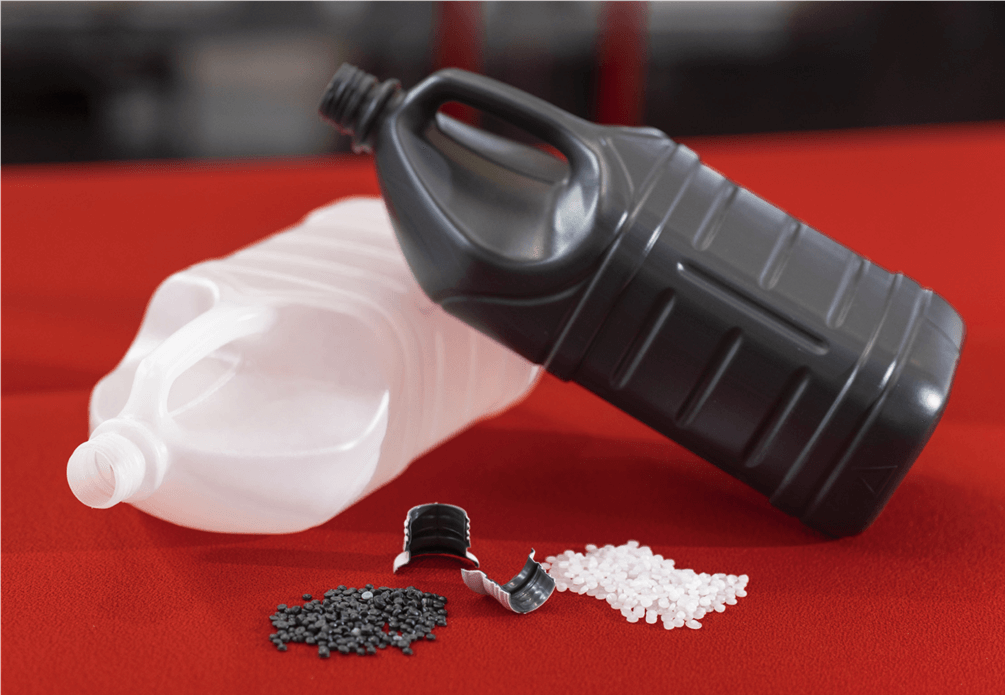

Design and marketing play a non-secondary role in the ecological transition that is required: the weight of the containers must continue to decrease, the number of colors used must be reduced to promote recyclability, while rapid colors changeover became a must for the extrusion heads.
The new generation machines will have scalable solutions for the extrusion process, in a way to allow the use of bio-compostable and / or biodegradable materials: these materials are available, but still in limited quantities and at relatively high costs.
On this topic it is worth mentioning a recent Market Survey, which highlighted the willingness of consumers belonging to the “baby boomer” and “Z” generations to pay a higher figure for a product that is presented in “ecofriendly” bottles.
Returning to the topic of blow moulding extrusion machines, it is absolutely necessary to reduce energy consumption: a statistical census of the existing machinery fleet on the Western market has revealed that it consists of more than 73% of hydraulic motion machines.
The transition to electric machines is worth a direct energy saving of over 35% and overall indirect, including the costs of utilities and maintenance, of over 55%: this is one of the milestones for the application of the concept of circular economy to this technology.
Not only, the accurate management of the downstream of blow moulding extrusion machines, the drastic reduction of personnel related to the final packaging of the bottles, the degree of automation and traceability of the product are other elements of challenge and cost reduction of HDPE bottles.
At this point, the circular economy, the ecological transition and the Industry 4.0 concept meet, in order to generate innovative production processes, with plants including low labor intensity, low energy consumption and high efficiency, fully interconnected, and resulting in competitive TCO.
This scenario, compatible with the general evolution of the modern world, requires economic investments, technological research and, most importantly, the commitment of companies to achieve the set goal, otherwise their competitiveness will be significantly reduced.
Alphamac, as a company belonging to the IMA Group, one of the world leaders in the packaging machinery industry, has been following these guidelines and it offers to the market machines and complete solutions that cover the needs dictated by this further step forward of a fascinating technology and that, born seventy years ago, still finds its valid place in the world of packaging for fluid products.
