Leveraging 30 years of experience from its founders, Makro was born in 2009 and rapidly grew to become an international market leader. Our mission is clear: to design cutting-edge labellers that withstand the tests of time, satisfy every customer’s evolving production needs and offer maximum benefit and reliability.
With a meticulous ‘made-in-Italy’ production, we combine technological, mechanical and electronic innovations with environmentally friendly production processes, based on energy savings and knowing how to effectively implement a more sustainable economic development model. We begin with a deep knowledge of every aspect of labelling and work with passion, professionalism, competence, and a commitment to always be near our customer for prompt service throughout the lifetime of your labeller.
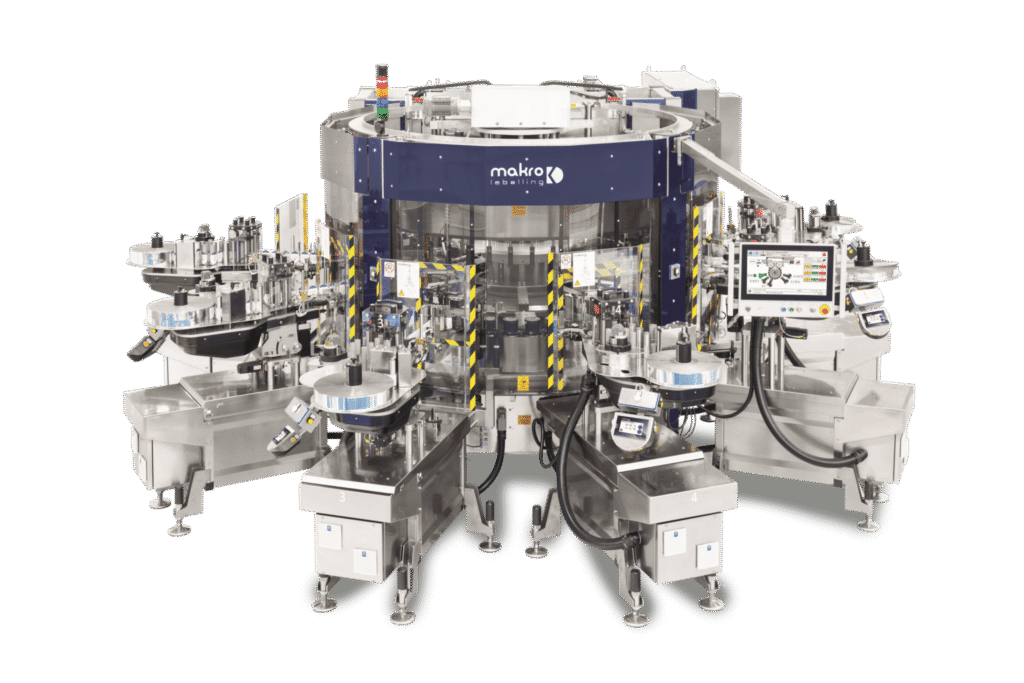
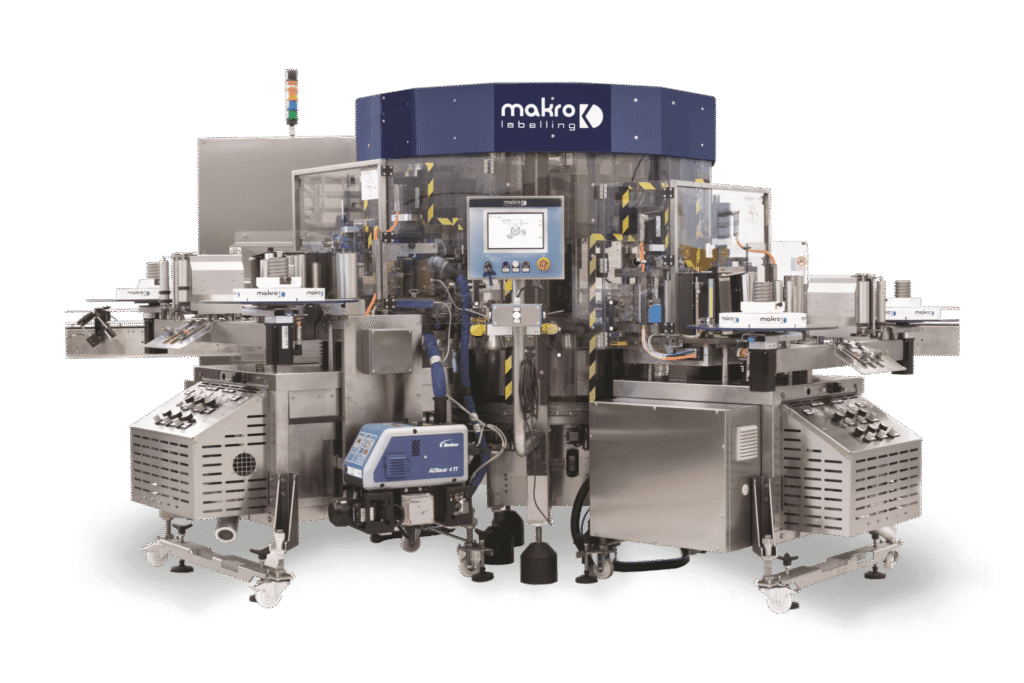
A range of labellers for production speeds of 1,500 to 50,000 b/h
The range includes labellers able to process from 1,500 to 50,000 bottles per hour, applying up to five labels per bottle and available in wet glue, hot melt, self-adhesive and combined versions.
For companies with limited production requirements, the MAK 01, MAK 02 and MAK 1 labellers provide speeds of up to 12,000 b/h with mechanical or electronic rotation of the bottle plates. With special applications and able to cope with production speeds of up to 50,000 b/h, the MAK 2, 3, 4, 5, 6, 7 and 8 labellers, on the other hand, satisfy the needs of medium to large companies.
The range includes a high speed self-adhesive labeller with reel winders and nonstop system enabling production to continue at maximum speed even during reel changes and a combined labeller to apply the fiscal guarantee seal. Thanks to a special, patented paper delivery system, the MAK AHS2 self-adhesive labelling module responds to the need for faster, more precise machines. It guarantees a linear speed of 100 metres a minute at a label pitch of 20 mm.
For the high volume PET market, such as the water and soft drinks sector, Makro Labelling has developed the MAK Roll Feed series of rotary labellers: The 6,000 b/h to 40,000 b/h production speed and use of wrapround plastic labels on a reel with hot melt application guarantee maximum economic benefits in the production process.
The modularity of the machine also allows the roll feed unit to be replaced with a hot melt unit for pre-cut, wet glue or self-adhesive labels.
In common with the entire Makro range with the Vision Control system to verify the quality and correctness of the packaging and manage rejects: two new inspection systems – RAPTOR (Rapide to Orientate) and A.L.I.C.E. (Advanced Label Inspection and Control Environment), which guarantee high performance, less production rejects and the highest finished product quality.
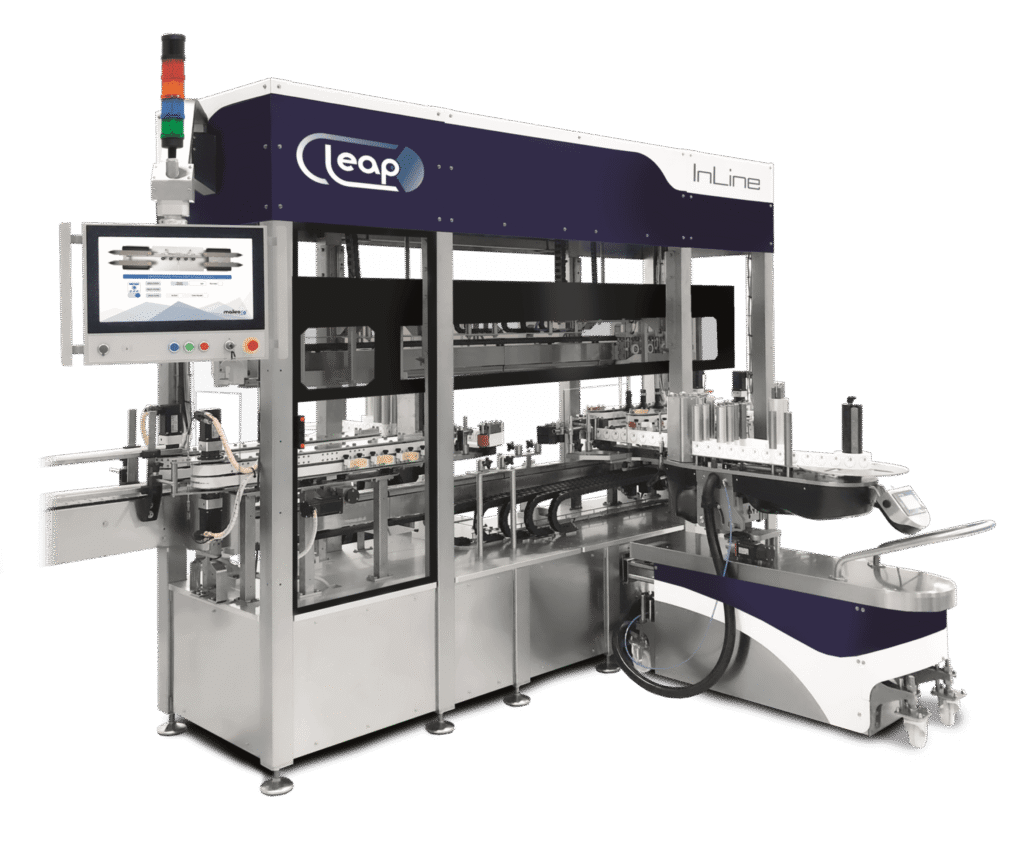
CLeap (Concept Leap)
Makro has created and presented a new labelling machine concept using long stator linear motor technology, the Cleap InLine.
Thanks to the rotation of the plates, it is the only linear labeller with centering which, in addition to high labelling accuracy and speed, also offers the advantage of not having to change format: within minutes, the operator is ready to start production again. Its versatility and production flexibility make it ideal due to its small footprint.