
With some delay, the issue of sustainability has also made inroads into the packaging of pharmaceutical products. Why has it taken a bit longer than in other sectors for this to happen?
When packaging health products like medicines and medical goods, patient safety is the top priority. Hygiene is therefore crucial at all stages, from packaging process to patient.
During transportation and storage, packaging protects the products from environmental influences and damage due to impact, dropping and pressure.
But the packaging of pharmaceutical products is not just about the protective aspect. Essential information for patients and nursing staff about the administering of the medicines needs to be printed in a highly visible form on the primary and secondary packaging.
Not only are there statutory regulations in place regarding font type and size, a lot of other mandatory information also needs to be displayed on the surface of the packaging. All drug packaging must show a unique serial code (USC) in combination with the item number (GTIN, global trade item number), batch number (LOT), expiry date (EXP) and name of the manufacturer.
The USC is an individual identifying feature consisting of an encrypted series of numbers in a 2D data matrix code for the purposes of traceability. As part of the serialization process, which must already be ensured during the packaging of the products, the numbers are stored in a secure database as verifiable proof of origin.
Apart from this code, a tamper-proof closure such as an adhesive sticker also must be applied to the packaging to show if any tampering has occurred. Both stipulations are designed to prevent health risks by making it difficult to smuggle counterfeit products into the legal supply chains.
The German system that organizes these security aspects is SecurPharm and is based on the EU Directive on Counterfeit Protection that came into force a few years ago.
Approval processes impede shift to sustainable packaging
Another factor is that apart from statutory requirements, aspects like childproof closures or senior-friendly packaging design are also important considerations. Larger closures that are easier to open, tabs and other opening aids naturally increase the cost of packaging. The same applies to other safety features and additional childproof seals.
Ultimately, the complicated approval processes for the packaging of pharmaceutical products also make life difficult for sustainability teams. New packaging is subject to a compliance process covering various aspects like printing inks, adhesives and material of labels, or vapour and oxygen permeability.
In this context, the shift to more environmentally compatible alternatives must not jeopardize the granting of approvals by the US FDA or its European counterpart, the EMA.
There are options for more sustainability
Despite this difficult framework, more environmentally compatible packaging is still possible in the pharmaceutical sector. Products packed in paper-based folding box are the easiest to make more sustainable.
For example, many companies want to ensure that the fibre comes from sources certified as renewable. To make packaging recyclable it is important to dispense with coatings, provided of course that the printing inks for the mandatory information remain legible and do not blur.
The same applies to adhesive labels and of course to the package inserts, which are generally extensive. If fragile syringes, glass bottles or vials need to be protected, plastic inserts and separators can be replaced by fibre-based liners.
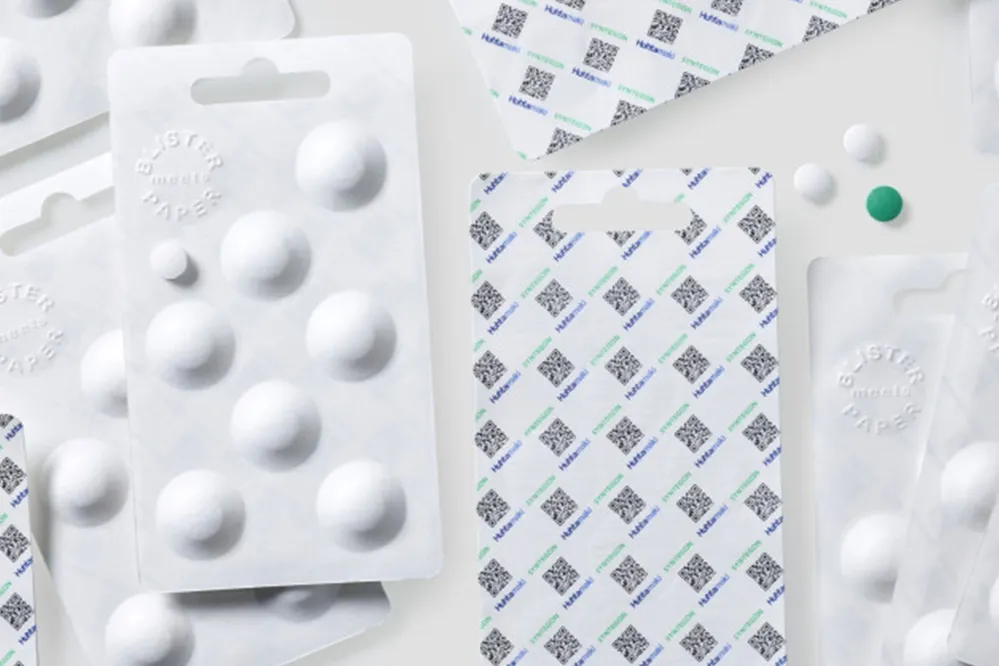
For a long time, there was no alternative to the PVC and aluminium blister packs generally used for tablets. But the pharmaceutical players participating in FACHPACK, and at the POWTECH exhibition taking place alongside it this year, are now offering innovative and sustainable alternatives.
“The fact that the two fairs are taking place at the same time in 2022 is a stroke of luck for the pharmaceutical sector,” says Dr Martin Bornhöft from the APV (International Association for Pharmaceutical Technology), who is also a member of the POWTECH advisory board. “Trade fair visitors can now get a comprehensive insight into the entire supply chain, from process to technology and packaging.”
One of the possible alternatives on display at FACHPACK, for example, is PP-based, halogen-free thermoforming film, which offers good barrier properties yet is recyclable. In the meantime, these films also come in renewable biopolymers, so they not only improve recycling capacity but also the carbon footprint overall. In 2021, the German Packaging Award from the German Packaging Institute was won by Syntegon for its sustainable blister packs.
The paper-based blister packs presented at FACHPACK 2021 were developed in partnership with Finnish packaging material manufacturer Huhtamaki and offer an environmentally friendly alternative to conventional press-through packs for tablets.
Pharmaceutical company Sanofi is taking an approach that involves the patients themselves. Together with TerraCycle, it initiated a collection system in the UK that allows empty blister packs to be returned to participating pharmacies. TerraCycle uses a special recycling process to recover reusable raw materials from the blister packs.
However, the objective of developments in packaging design for medical products is to enable them to be readily recycled using the existing recycling infrastructure.
It may be an advantage that the pharmaceutical sector is lagging a little behind other industries in this respect because it can therefore learn from the mistakes of others and has access to proven alternatives.